
Franklin Projected Versus Actual Release
A projected date is a current calculation, not a promise. It may estimate when the prison portion of a sentence will end after available credit. The actual release date is the day custody changes in practice. Processing, a court order, credit recalculation, discipline, a detainer, or a new case can separate those two dates. Final discharge is another milestone. It may occur only after parole or postrelease supervision ends.
Scheduled versus actual release: A future date can move. Confirm the actual custody-ending event with the jail or KDOC and identify any receiving agency.
Pretrial custody is different. A person held at the Franklin County Adult Detention Center before judgment does not have a sentence-based release date. A bond order may authorize release, but the person can remain while conditions are completed or another hold is resolved. The court order supplies legal authority. The jail record supplies the operational exit time and disposition.
A transfer is not release home. A Franklin jail booking may end because the person went to KDOC, another jurisdiction, or ICE. If KASPER later shows Inmate, state custody continues. If the jail identifies a receiving agency, follow that system instead of describing the booking end as freedom.
Find a Franklin Projected Release Date
The correct route follows the custodian. Franklin County publishes no official live jail roster, recent-release archive, or county sentence calculator. For a county case, start with the judgment and Adult Detention. For a state sentence, use the Kansas Adult Supervised Population Electronic Repository, known as KASPER. It covers KDOC-operated and KDOC-funded programs, not the county jail.
- Confirm whether the person is pretrial, serving a county-jail sentence, or committed to KDOC. Use the court docket and the last known custodian.
- For county custody, call Adult Detention at 785-229-1220. Ask for the release calculation or the route to request the custody history and disposition.
- For state custody, agree to the KASPER disclaimer. Search by KDOC number when known, or use name, aliases, and advanced identity filters.
- Open the matching record only after checking identifiers. Read every date exactly as labeled and do not turn an eligibility date into a promised release.
- Confirm a future state date with KDOC when credits, detainers, or sentence structure make the record unclear. Confirm an actual county exit with the jail record.
KASPER basic search offers last, first, and middle name, alias searching, KDOC number, and photo choices. Advanced search adds birth and demographic details, conviction county, parole county, Community Corrections location, and supervision type. Useful status choices include Inmate, Parole, Community Corr., Absconder, and Discharged. Those statuses describe different points in the custody and supervision chain.
The automated research could not pass the KASPER CAPTCHA to verify a live detail label. Therefore no specific “projected” or “tentative” field name should be assumed. The Franklin County release-record search provides the wider county, court, VINE, state, and transfer paths when the custodian is uncertain.
Kansas Good Time for Franklin Releases
K.S.A. 21-6821 authorizes KDOC good-time rules and caps how much credit can be subtracted from the prison portion. For many crimes committed on or after July 1, 1993, the maximum credit is 15 percent. That produces the common “about 85 percent” shorthand only when the sentence falls in that category and all available credit is earned and kept. It is not a universal Kansas rule.
The statute permits a 20 percent maximum for nondrug severity levels 7 through 10 committed on or after January 1, 2008, as well as specified lower drug-severity crimes and dates. Offense date, severity level, sentence structure, conduct, forfeiture, and restoration all matter. Applying one percentage to every Franklin County conviction would produce false dates.
For a determinate guideline sentence, KDOC explains that release to postrelease supervision occurs after the maximum prison term less earned good time. Earned credit is added to postrelease supervision. In practical terms, credit often shifts days from prison into supervised community status instead of erasing the full legal obligation.
The official good-time statute is captured below from the Kansas Revisor of Statutes.
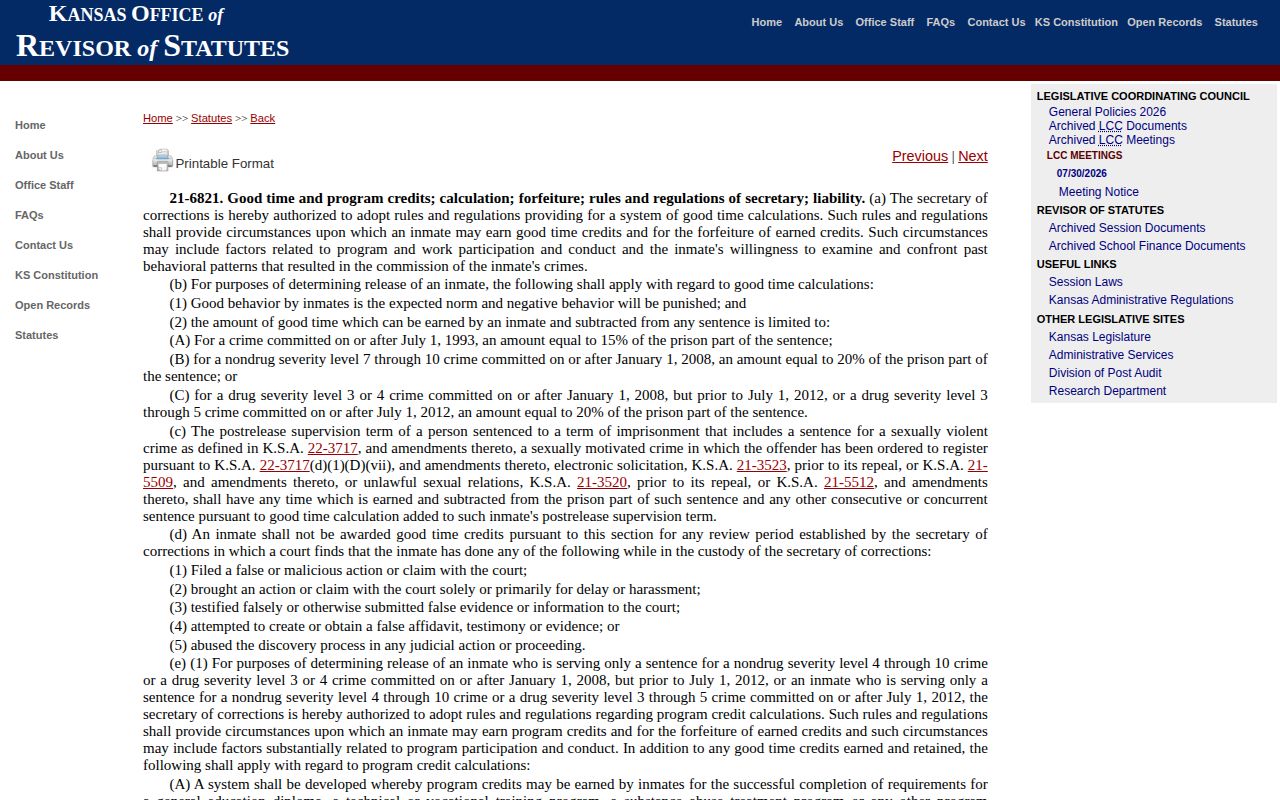
Its categories and limits show why the sentence and offense date must be known before estimating a state-prison release.
Franklin County jail sentences have a separate problem: no local good-time, earned-time, or weekend-release policy was found. KDOC percentages cannot be copied onto a county-jail commitment. Obtain the court order, jail credit, and the jail's own current computation.
Why Franklin Release Dates Change
A calculation changes when one of its inputs changes or when another custodian has a valid claim. The public record may also lag the agency's working file. KASPER says its information is updated each working day, so a recent sentence or credit action may not appear at once.
| Factor | Effect on the date or destination | Best confirming record |
|---|---|---|
| Good-time earning | May advance the end of the prison portion within statutory limits | KDOC calculation and K.S.A. 21-6821 |
| Forfeiture or restoration | May move a projected date later or earlier | KDOC credit record |
| Jail credit | Changes credited time under the sentence | Journal entry and sentence computation |
| Concurrent or consecutive terms | Changes how multiple terms combine | Court judgment and KDOC computation |
| Detainer or hold | May turn release from one custodian into transfer to another | Receiving-agency and release-disposition fields |
| Later court order or violation | Can modify, revoke, or otherwise change the operative term | Court docket and agency record |
| Parole decision | For eligible indeterminate sentences, eligibility may or may not lead to release | PRB decision record |
K.S.A. 22-3717 contains many offense-date exceptions, postrelease rules, and provisions for mandatory, life, and off-grid sentences. It should not be reduced to a single online calculator. Eligibility means the legal point at which release may be considered. It is not the same as suitability, an order granting release, or the day a person walks out.
Confirm Franklin County Release Timing
County-jail and state-prison notifications use different systems. Kansas VINE covers adults in participating county jails, including the locally documented Franklin implementation. It expressly excludes KDOC prisoners. Registration should occur while the adult is still in county custody. A VINE release notice records a custody change, while a transfer notice says another custodian may now hold the person.
The Franklin County VINELink check explains prospective registration by phone, email, text, or available in-app methods. It is not a state-prison date calculator and does not promise a permanent released-person record. For KDOC custody, use KASPER and the separate KDOC victim-notification process where eligibility applies.
For the strongest county proof, pair the court order with the jail custody record. The Franklin District Court entry can show sentence, bond, jail credit, revocation, or discharge. Adult Detention can identify the operational release or transfer. If a formal record is needed, request the custody history, release date and time, disposition, receiving agency, and authorizing order through Franklin County's open-records process.
Franklin Release Credit Becomes Supervision
Kansas good time often changes the boundary between incarceration and postrelease supervision. It does not necessarily shorten the entire sentence relationship. For determinate sentences, days credited against the prison portion can be added to the supervised portion. A projected physical-release date may therefore mark a major change in custody without marking discharge.
The Kansas Prisoner Review Board process explains the release structure and the Board's role. The successful source capture below shows the state process used to interpret a Franklin County state-prison date.

The process should be read with the sentence and current KDOC record, not as a stand-alone promise of release.
Older indeterminate sentences use another framework. PRB says parole eligibility may occur after the minimum term less applicable good time, but release remains a Board decision. Its current explanation describes one day of credit per day served for minimum terms of two years or more, and nine months for a one-year minimum when credit is earned. Conditional release generally relates to half the maximum if good time is not lost. None of those points guarantees parole.
After physical release, the Lawrence Parole Office serves Franklin County KDOC parole and postrelease cases. A later Discharged status or formal discharge record addresses the end of that supervision. This is why “gets out” must be split into prison exit, supervision start, and final discharge.
Franklin County Jail Date Limits
The Franklin County Adult Detention Center at 305 S. Main in Ottawa is the county jail, not a KDOC prison. A pretrial detainee's timing turns on the court, bond conditions, and holds. A person serving a county sentence needs the jail's calculation. No official Franklin County policy was located for county good time, weekend release, a fixed processing hour, or a public sentence calculator.
Call Adult Detention at 785-229-1220 and ask whether the person is now confined. If the question concerns a county sentence, ask which existing record shows jail credit and the calculated release point. If the booking ended, ask whether the disposition was community release, KDOC transfer, another-jurisdiction transfer, or ICE transfer. A website absence cannot answer that question because Franklin County publishes no official current roster or release archive.
A narrow Kansas Open Records Act request can seek the booking sheet, jail register or custody history, release date and time, disposition code or narrative, receiving agency, and order identifier. K.S.A. 45-218 requires prompt action and a response by the end of the third business day, but that deadline is not a promise that records will be produced within three days. Actual-cost fees and advance payment may apply, and the county posts no fixed jail-record fee.
The request should name the person, include a booking number or date of birth when lawfully available, and narrow the booking period. Ask for existing fields instead of asking staff to calculate a new date for publication. If the County replies that it has no record, that response does not search KDOC, a court, ICE, or another jurisdiction. A referral should be followed to the named custodian. When a production uses an unexplained disposition code, ask whether the office maintains an existing code key or plain-language legend.
When court and jail dates differ, retain both. A judge can sign an order before operational release processing ends. Another hold can also delay departure. The court timestamp is the legal action, while the jail timestamp marks the custody event. Replacing one with the other would hide a useful part of the Franklin County release history.
Note: Do not apply KDOC good-time percentages to a Franklin County jail sentence without an official county computation.