
Franklin County Parole Versus Probation
Supervision in Franklin County depends on the judgment and the custodian that released the person. Parole is physical release from an eligible indeterminate Kansas prison sentence under conditions set through the Kansas Prisoner Review Board. Postrelease supervision follows the prison portion of most determinate guideline sentences. Probation is imposed by a court and may avoid or follow jail time. It can be supervised by Court Services or by Fourth Judicial District Community Corrections. Those local offices are separate from Kansas Department of Corrections Parole Services.
| Status | How it starts | Franklin County verification route |
|---|---|---|
| Parole | PRB release from an eligible indeterminate prison sentence | KASPER, PRB records, and the Lawrence Parole Office |
| Postrelease supervision | Follows the prison portion of a determinate sentence | KASPER and the Lawrence Parole Office |
| Court Services probation | Ordered in a district court case | Franklin District Court docket and Court Services |
| Community Corrections | Court-ordered supervision through the four-county program | Court order and Fourth Judicial District Community Corrections |
A county-jail release can occur with no KDOC supervision at all. Someone may leave on bond, after time served, or under a local probation order. By contrast, a KASPER status of Parole reflects state supervision after physical release. A Discharged status indicates the KDOC custody or supervision association has ended. Check identity and dates before drawing that conclusion.
- Parole
- Conditional physical release from an indeterminate prison sentence.
- Postrelease supervision
- The supervised part that follows a determinate prison term.
- Probation
- A court-ordered community placement supervised under the judgment.
- Discharge
- Formal completion or termination of the listed custody or supervision relationship.
Verify Franklin County Post-Release Supervision
Begin with the sentence source, not a guess based on where the person lives. The Franklin County case-information gateway leads to the Kansas public court portal for state criminal cases. A sentencing entry can identify probation, Community Corrections, a prison commitment, revocation, or discharge. For KDOC custody or funded supervision, use the KASPER search gateway. It updates each working day, requires agreement to its disclaimer, and is not the Franklin County jail roster.
- Open the court case and read the judgment, probation order, revocation entries, and any later termination order.
- If the sentence involved KDOC, search KASPER by KDOC number when known. Otherwise use full name, aliases, and identity filters.
- Read the exact status. Inmate, Parole, Community Corr., Absconder, and Discharged do not mean the same thing.
- Match the status to the proper office. Call Lawrence for KDOC parole or postrelease, Court Services for that court track, or Community Corrections for its cases.
- Ask for the public record or office that can confirm current supervision or formal discharge when portal data is unclear.
KASPER warns that Community Corrections probation events after April 21, 2021 may not display during system modernization. A blank or stale result is weak proof for a Franklin County probation case. The court order and the local supervising office carry more weight for that gap. The Franklin County released-inmate search paths also explain how to distinguish a community release from a transfer into state custody.
Franklin County Supervision Office Map
Franklin County has no KDOC parole office in Ottawa. State parole and postrelease cases route to Lawrence. Local probation work can instead belong to Court Services or Community Corrections, both in Ottawa but at different addresses. The judgment and docket should identify the track. Do not choose Community Corrections simply because it has “corrections” in its name.
Lawrence Parole Office, North Region
1800 E. 23rd St., Suite K
Lawrence, KS 66046
785-842-2926
Serves Franklin, Douglas, Coffey, and Anderson Counties. KDOC also lists its Automated Reporting System at 866-570-7225.
Franklin Court Services
301 S. Main
Ottawa, KS 66067
785-242-5433
Fourth Judicial District Community Corrections
226 S. Beech
Ottawa, KS 66067
785-229-3510
Monday through Friday, 8 a.m. to 5 p.m.
Serves Franklin, Anderson, Coffey, and Osage Counties.
The official Franklin Court Services page shows the local court track. The captured page below helps distinguish it from other forms of post-release supervision.
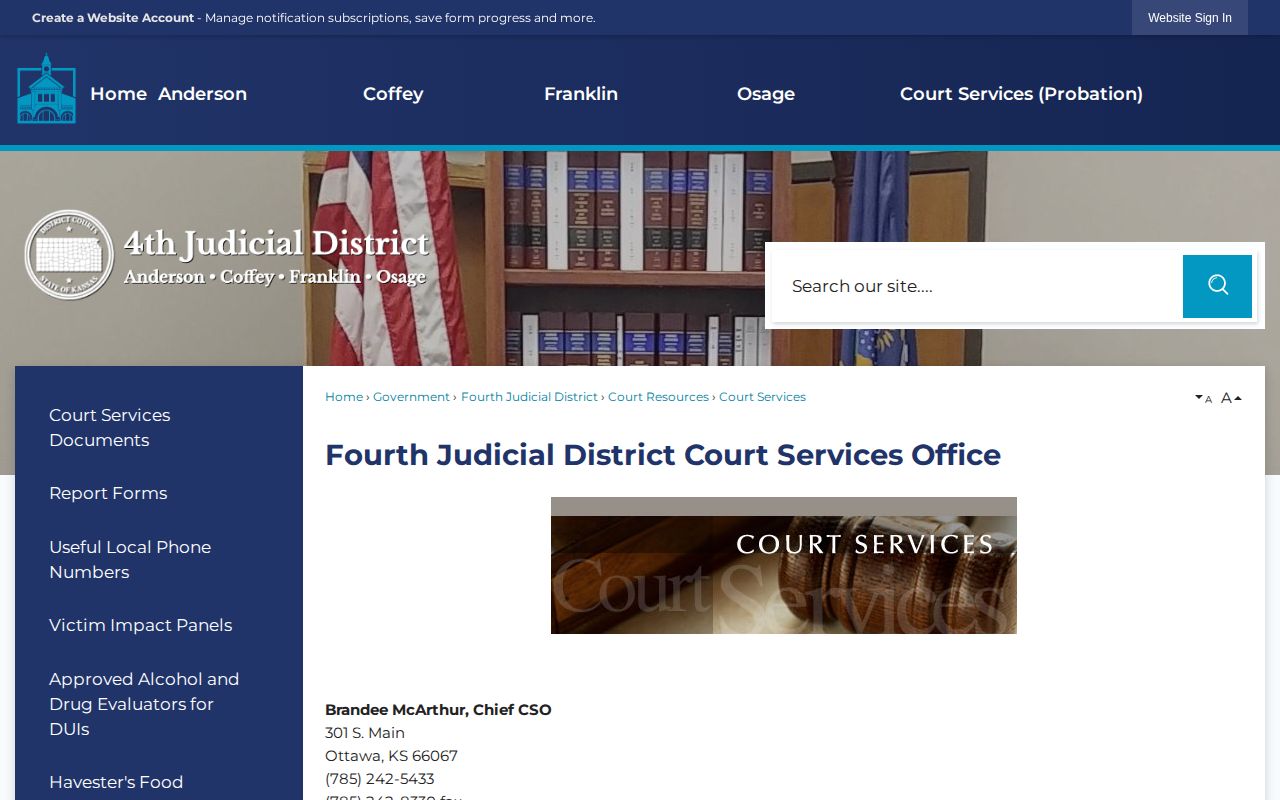
That local office is not the KDOC parole office and should be matched to the sentencing order before contact.
Franklin County Absconder Record Limits
An absconder is a person alleged to have stopped complying with supervision or whose location is not known to the supervising agency. It is not a discharge. It also is not proof that the person is now in jail. Conditions can include reporting, treatment, travel limits, or other terms in the order, but the exact terms must come from the actual record. Violations may lead to added conditions, revocation proceedings, or a warrant.
The KASPER parole-absconder display is updated each working day. Its warning matters: no one should try to arrest or detain a person based only on that page. Send urgent public-safety information to law enforcement. KDOC lists Enforcement, Apprehensions and Investigations at 785-414-7755 for questions about its absconder information.
The source capture shows the official Franklin County supervision lookup route and its limited status function.
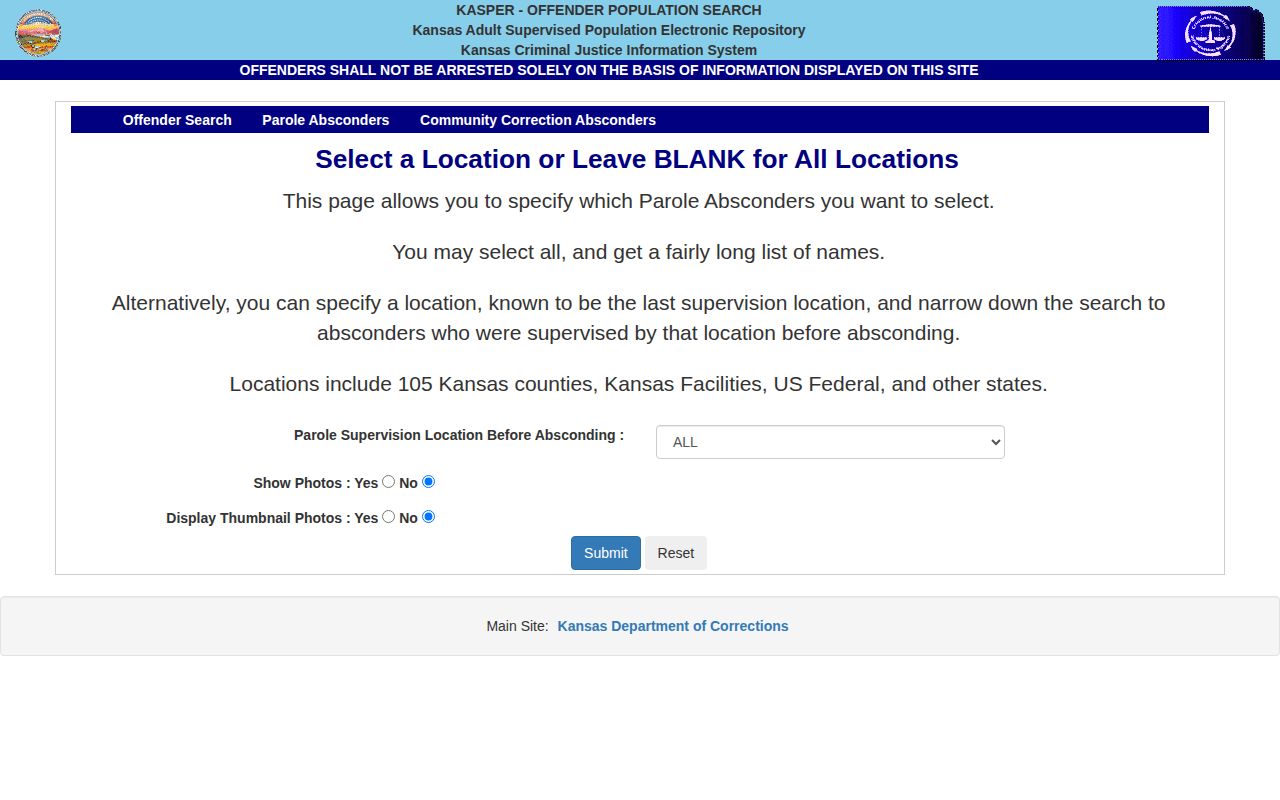
Use the display as a lead for agency confirmation, not as proof of supervision completion or authority for private action.
County VINE does not track probation or parole. Kansas VINE covers custody events for adults in participating county jails and expressly excludes KDOC prisoners. A release or transfer notice can document a jail custody change, but it cannot establish that supervision ended. KDOC has a separate victim-notification program with eligibility limits.
How Franklin County Supervision Ends
Physical release and supervision discharge are separate milestones. A person may leave prison and begin parole or postrelease supervision. A person may leave the Franklin County Adult Detention Center and begin probation. Neither event means the full legal obligation is over. Completion may be shown by a KASPER Discharged status, a court termination order, or an official PRB or KDOC action, depending on the sentence.
For state supervision, compare KASPER with the Lawrence office when working-day updates or a status label leave doubt. For probation, look for a signed court order ending supervision. Kansas open-records rules allow requests for existing public records, subject to exemptions. They do not require an office to create an answer that it does not keep. A focused request should identify the person and case, ask for the discharge or termination record, and avoid excess private data.
Expungement is different from discharge. K.S.A. 21-6614 provides offense-dependent waiting periods and exclusions. In one common category, the waiting period begins after the sentence is satisfied or discharge from probation, Community Corrections, parole, postrelease, conditional release, or a suspended sentence. A vanished public result may reflect restricted access, not proof that custody or supervision never occurred.
Franklin County Community Corrections Split
Fourth Judicial District Community Corrections is a four-county program based in Franklin County. Its placement at 226 S. Beech can cause confusion because Court Services operates from the courthouse and KDOC parole routes to Lawrence. The county expressly states that Community Corrections is not Court Services. Each receives authority from a different part of the case record.
The official Community Corrections page identifies the program and its local base. This successful source capture preserves that Franklin-specific distinction.
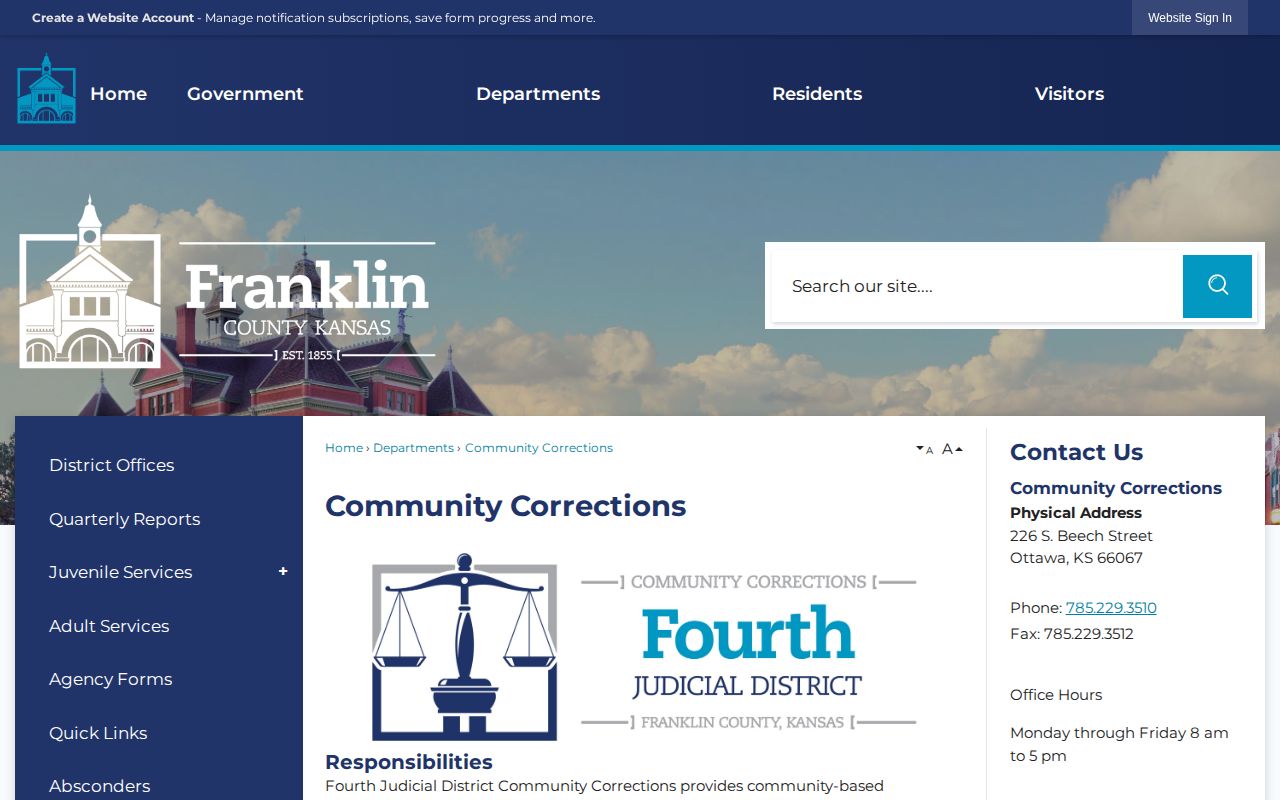
Before calling, use the docket to learn whether the order names Community Corrections, Court Services, or KDOC Parole Services.
Property After a Franklin Release
An official county report from 2013 said remaining inmate-account funds were reimbursed at release and described the TurnKey system then in use. It is historical evidence, not a statement of current Franklin County Adult Detention Center policy. The detention center must confirm how property and account balances are handled now.
That distinction also helps when supervision begins. A property receipt or account record documents jail processing, while a probation or parole order documents the next legal status. Ask Adult Detention at 785-229-1220 about current release property procedures. Ask the proper supervision office about reporting duties. Combining the two questions can lead to an answer from the wrong custodian.
Note: Historical account practices should never be presented as current without direct confirmation from Franklin County Adult Detention Center staff.
Franklin County Parole Hearing Records
The Kansas Prisoner Review Board decides parole for eligible indeterminate sentences, sets supervision conditions, considers discharge recommendations, and decides revocations. Determinate sentences work differently. For them, the prison release point is generally based on the court sentence and KDOC calculation, while the Board sets postrelease conditions.
PRB holds monthly public-comment sessions in Derby, Topeka, and Kansas City. Its schedule and listed-offender pages change each month. They show opportunities for input, not the final decision. The PRB process page describes parole, continue, and pass outcomes. “Continue” means more review, votes, information, or evaluation is needed. “Pass” means denial for a stated period. No public individual decision-results database was found.
A pass can extend as long as ten years for an A or B felony or an off-grid offense, and as long as three years for other offenses. The stated reason and the person's sentence still control. A written appeal under K.A.R. 45-200-2(b) depends on new evidence that was not available before the decision. The public-comment list cannot establish any of these results because it identifies people scheduled for comment rather than publishing grants, denials, or later discharge actions.
Eligibility under K.S.A. 22-3717 depends on the offense, date, and sentence structure. It does not promise release. For one Franklin County person, use the current PRB schedule only to identify the proceeding, then seek the actual decision from PRB, the person or counsel, or an appropriate records request.